

However, getting a personal loan depends on your financial profile. Banks and NBFCs usually check your income, credit score, employment stability, existing loan obligations, repayment capacity and documents before approving the loan.
In this blog, we will explain personal loan eligibility, documents required, step-by-step application process, approval tips and important points to check before applying.
What Is a Personal Loan?
A personal loan is an unsecured loan that can be used for different personal financial needs. Unlike a home loan or vehicle loan, a personal loan is usually not linked to a specific asset. The approved loan amount is disbursed to your bank account, and you repay it through monthly EMIs over a fixed tenure.
Personal loans are commonly used for:
- Medical expenses
- Wedding expenses
- Education-related expenses
- Home renovation
- Travel expenses
- Debt consolidation
- Emergency cash requirement
- Other personal financial needs
A personal loan can be helpful, but it should be taken only after checking your EMI affordability and repayment plan.
Personal Loan Eligibility Criteria
Eligibility criteria may vary from lender to lender, but most banks and NBFCs check some common factors before approving a personal loan.
1. Age of the Applicant
Most lenders prefer applicants who are adults and have a stable source of income. Generally, the common age range for personal loan applicants is around 21 to 60 years, but this may change depending on the lender’s policy, employment type and income profile.
2. Stable Monthly Income
Your monthly income is one of the most important factors in personal loan approval. Lenders want to know whether you can comfortably repay the EMI every month. A salaried person should have regular salary credits, while a self-employed person should be able to show steady business or professional income.
3. Employment Type
Both salaried and self-employed individuals can apply for a personal loan. Salaried applicants may need salary slips and bank statements, while self-employed applicants may need ITR, business proof and bank statements.
4. Credit Score
Your credit score shows your past loan and credit card repayment behavior. A good credit score can improve your chances of approval and may also help you get better loan offers. If your credit score is low, the lender may offer a lower loan amount, charge a higher interest rate or reject the application.
5. Existing EMI Burden
If you already have multiple loans or high credit card dues, your personal loan approval chances may reduce. Lenders check your existing EMI burden to understand whether you can manage one more EMI.
6. Repayment Capacity
Repayment capacity means your ability to pay the monthly EMI after managing your regular expenses and existing liabilities. A strong repayment capacity improves your chances of getting a personal loan.
Common Eligibility Points
- Applicant should have a stable income source.
- Applicant should have valid KYC documents.
- Credit score should be healthy.
- Existing EMI burden should be manageable.
- Applicant should have repayment capacity.
Documents Required for a Personal Loan
The exact document list depends on the lender and your employment profile. However, most lenders generally ask for KYC documents, address proof, income proof and bank statements.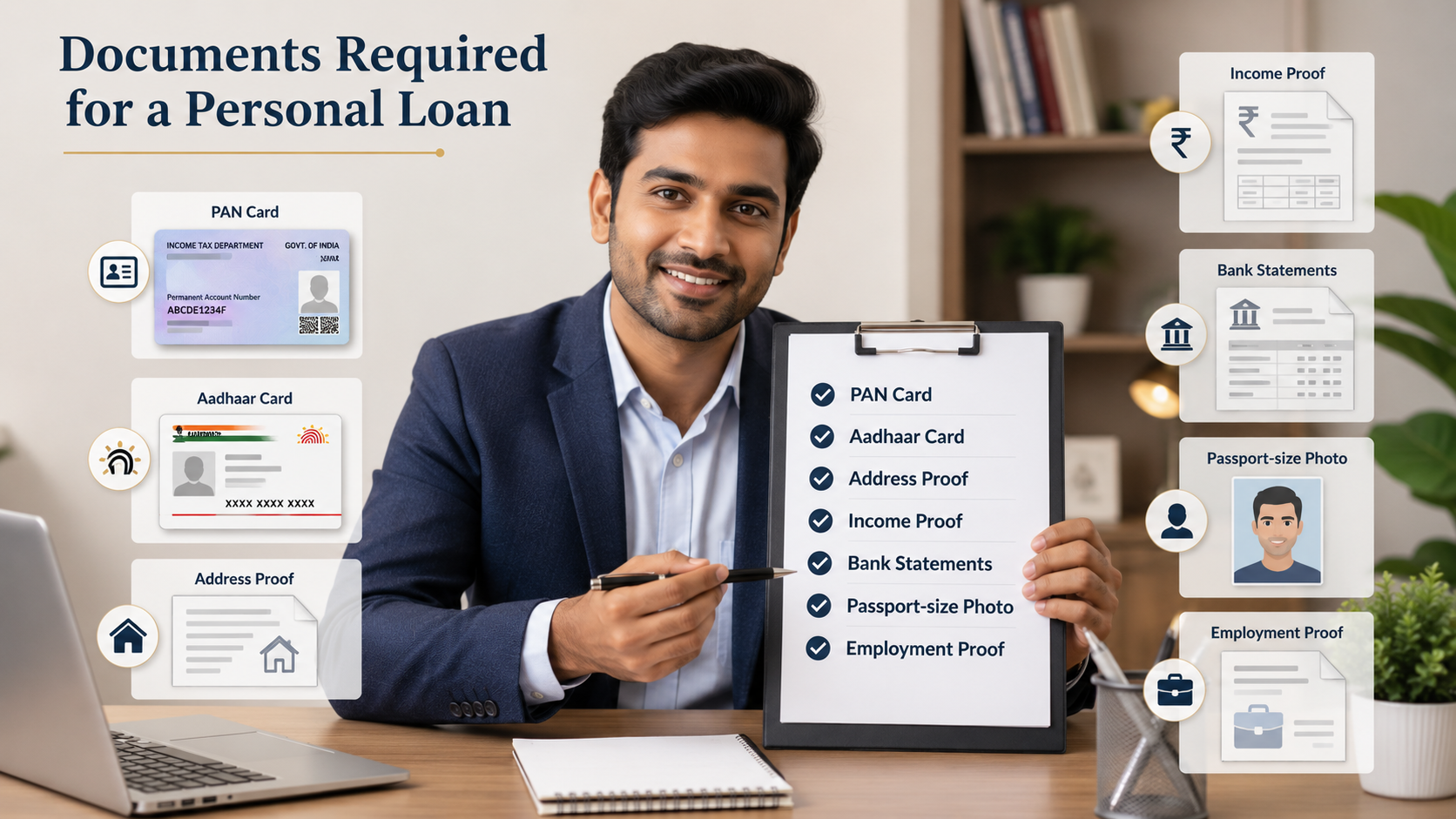
Basic KYC Documents
- PAN Card
- Aadhaar Card
- Voter ID
- Passport
- Driving Licence
Address Proof
- Aadhaar Card
- Electricity bill
- Rent agreement
- Passport
- Bank statement with address
- Utility bill
Income Proof for Salaried Applicants
- Latest salary slips
- Salary bank account statement
- Form 16, if available
- Employment ID or offer letter, if required
Income Proof for Self-Employed Applicants
- Income Tax Return
- Business bank statement
- Business registration proof
- GST registration, if applicable
- Profit and loss statement, if required
- Balance sheet, if required
Bank Statements
Lenders usually ask for recent bank statements to check income credits, business transactions, spending pattern and repayment capacity.
Common Document Checklist
| Document Type | Examples | Purpose |
|---|---|---|
| KYC Proof | PAN Card, Aadhaar Card, Passport | Identity verification |
| Address Proof | Aadhaar Card, Utility Bill, Rent Agreement | Address verification |
| Income Proof | Salary Slips, ITR, Business Income Proof | Income and repayment capacity check |
| Bank Statement | Recent bank account statement | Transaction and income verification |
Step-by-Step Personal Loan Process
The personal loan process can be completed online or offline depending on the lender. Here is a simple step-by-step process.
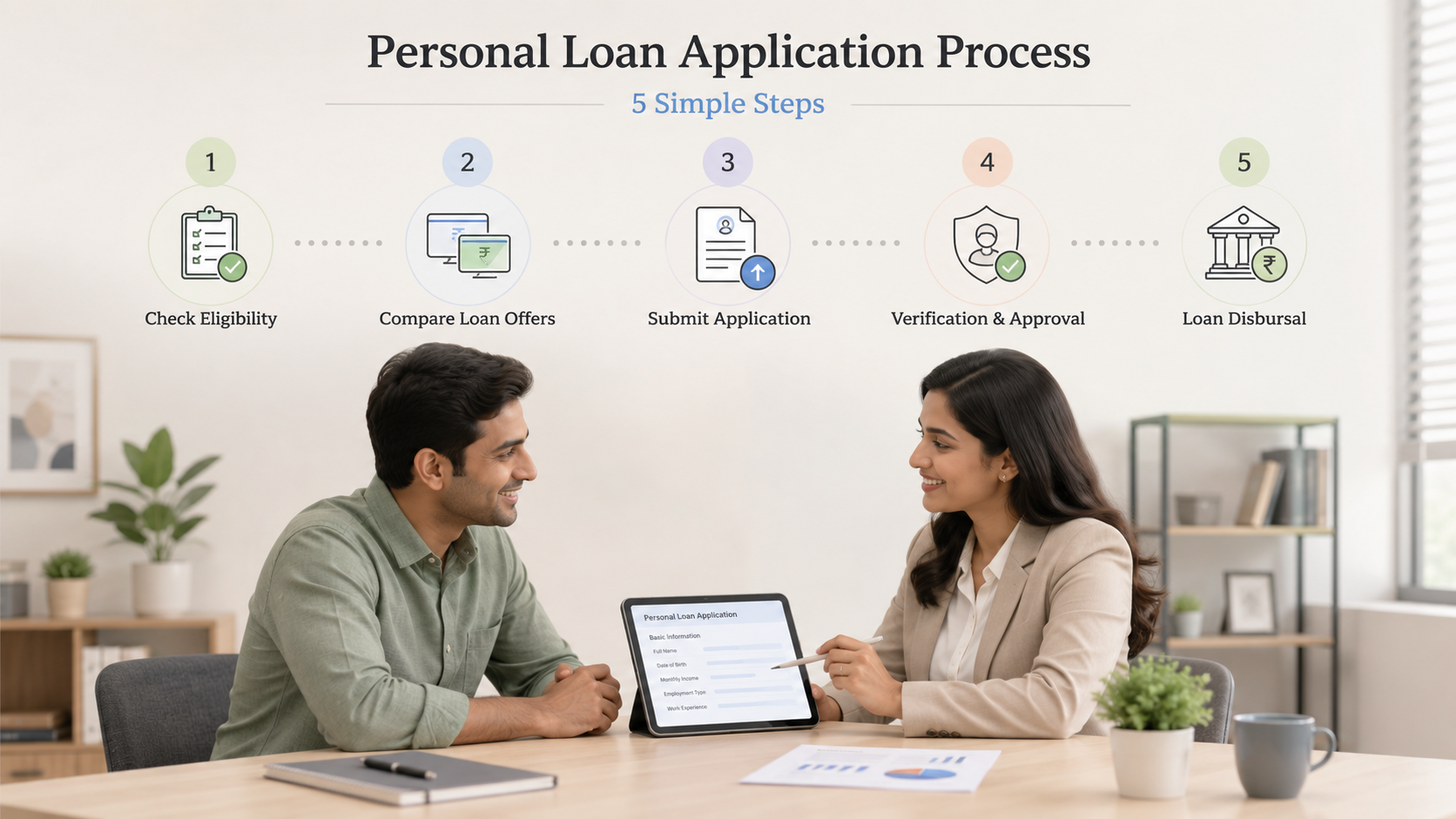
Step 1: Check Your Eligibility
Before applying, check your age, income, employment type, credit score, existing EMIs and loan requirement. This helps you avoid unnecessary rejections.
Step 2: Decide the Loan Amount
Choose a loan amount based on your actual requirement and repayment capacity. Do not apply for a higher amount only because you are eligible.
Step 3: Compare Loan Offers
Different lenders may offer different interest rates, processing fees and repayment terms. Compare the total cost of the loan before choosing an offer.
Step 4: Keep Documents Ready
Arrange your KYC documents, income proof, bank statements and employment or business proof before applying. Incomplete documents can delay approval.
Step 5: Submit the Application
Fill in your personal details, employment details, income details, PAN, mobile number and loan requirement carefully. Wrong or incomplete information can create problems during verification.
Step 6: Verification by Lender
The lender verifies your documents, credit profile, income and repayment capacity. They may call you for confirmation or request additional documents.
Step 7: Loan Approval and Disbursal
If your profile meets the lender’s policy, the loan can be approved. After final acceptance and agreement completion, the approved amount is disbursed to your bank account.
How to Improve Your Personal Loan Approval Chances
A strong financial profile can make the personal loan process easier. Here are some practical tips to improve your approval chances.
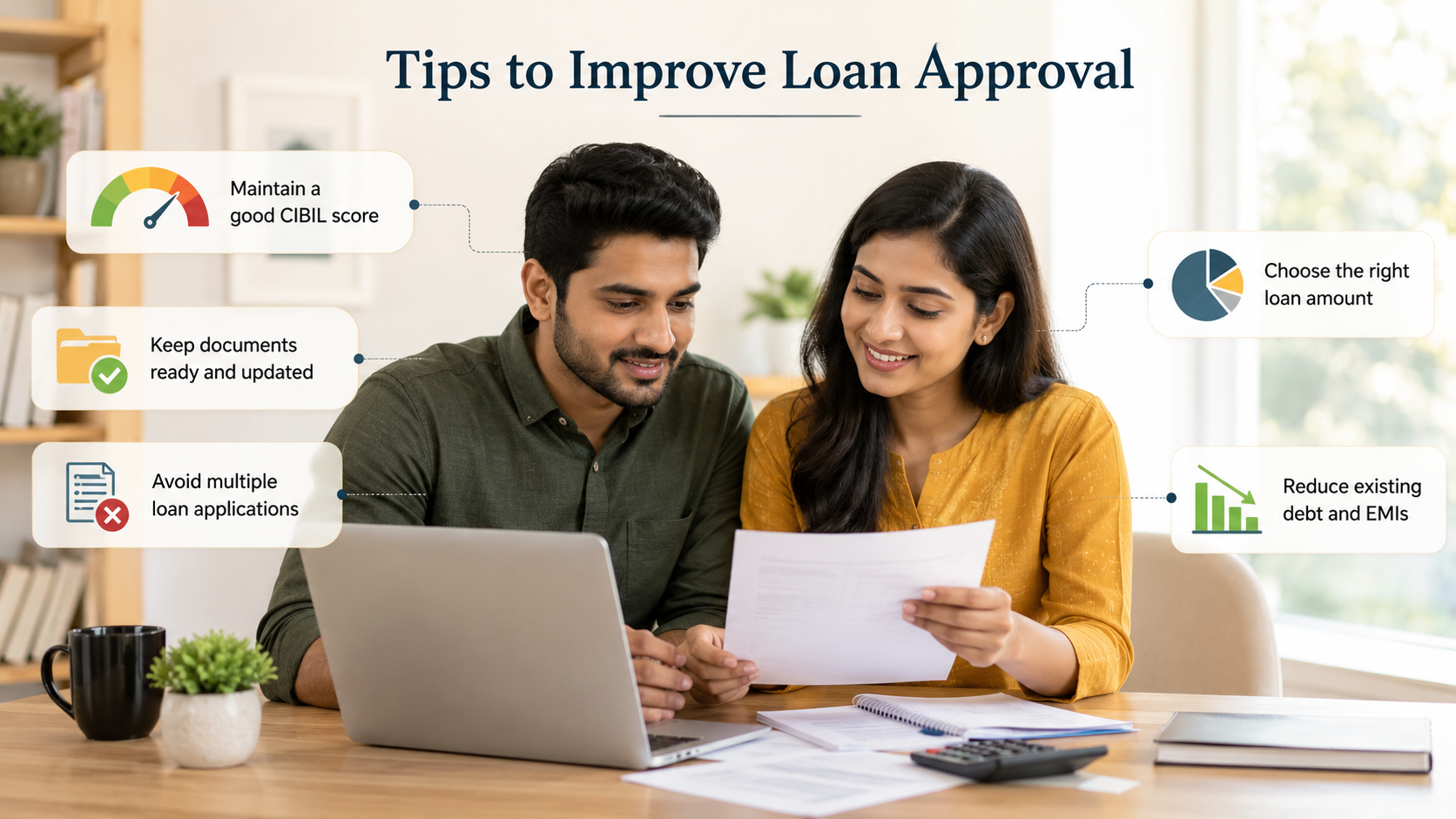
1. Maintain a Good Credit Score
Pay your existing EMIs and credit card bills on time. Late payments can affect your credit profile and reduce your chances of approval.
2. Keep Your Documents Ready
Complete and correct documents help the lender process your application faster. Make sure your name, PAN, address and bank details match properly.
3. Apply for the Right Loan Amount
Applying for a very high loan amount may reduce approval chances if your income does not support the EMI. Choose a practical and affordable amount.
4. Avoid Multiple Applications
Applying with too many lenders at the same time may affect your credit profile. It is better to check suitable options first and then apply carefully.
5. Reduce Existing Debt
If you already have many loans or high credit card outstanding, try to reduce them before applying for a new loan. This improves your repayment capacity.
Common Reasons for Personal Loan Rejection
Many personal loan applications get rejected because of weak financial profiles or small mistakes in the application.
- Low credit score
- Unstable income
- High existing EMI burden
- Incomplete documents
- Wrong details in application
- Frequent loan applications
- KYC mismatch
- Low repayment capacity
If your personal loan application is rejected, do not apply again immediately without understanding the reason. First, improve the issue and then apply with better preparation.
Important Things to Check Before Taking a Personal Loan
Before accepting any personal loan offer, check all loan terms carefully. A low EMI may look attractive, but a longer tenure can increase your total interest cost.
Check These Points Before Accepting the Loan
- Final approved loan amount
- Interest rate
- Monthly EMI
- Loan tenure
- Processing fee
- GST and other charges
- Prepayment and foreclosure conditions
- Late payment penalty
- Total repayment amount
Personal Loan EMI: Why It Matters
EMI is the monthly amount you pay to repay your personal loan. Your EMI depends on the loan amount, interest rate and tenure. A longer tenure may reduce your monthly EMI but can increase the total interest paid. A shorter tenure may increase EMI but can reduce your total interest burden.
Choose an EMI that fits your monthly budget. Missed EMIs can affect your credit score and future loan eligibility.
How MoneyMangalam Can Help
MoneyMangalam helps customers understand the personal loan process and connect with suitable loan options based on their profile and requirement. Instead of applying randomly, you can get proper guidance about eligibility, documents, loan amount and process.
Our team can assist you with eligibility guidance, document checklist, application support and basic loan process understanding. Final approval, loan amount, interest rate and disbursal depend on the lender’s policy and the applicant’s profile.
Frequently Asked Questions
1. What is the minimum salary required for a personal loan?
The minimum salary requirement depends on the lender, city, employment type and repayment capacity. A stable monthly income improves your chances of approval.
2. Is a credit score required for a personal loan?
Yes, most lenders check your credit score before approving a personal loan. A good credit score can improve your chances of approval and better offers.
3. Can a self-employed person get a personal loan?
Yes, self-employed professionals and business owners can apply. They may need to provide ITR, bank statements and business proof.
4. How long does personal loan approval take?
Approval time depends on the lender, applicant profile and document verification. If documents are complete and the profile is strong, the process can be faster.
5. Can I get a personal loan without collateral?
Yes, personal loans are usually unsecured, so collateral is generally not required. However, approval depends on income, credit score and repayment capacity.
6. What documents are required for a personal loan?
Common documents include PAN Card, Aadhaar Card, address proof, income proof, bank statements, employment or business proof and passport-size photo.
7. Why was my personal loan rejected?
Common reasons include low credit score, high existing EMI burden, unstable income, incomplete documents or incorrect application details.
8. Can I repay a personal loan before the tenure ends?
Many lenders allow prepayment or foreclosure, but charges and conditions may vary. Always check the lender’s terms before accepting the loan.
Conclusion
Getting a personal loan becomes easier when you understand the eligibility criteria, keep your documents ready and apply with the right lender. Before applying, check your income, credit score, EMI capacity and actual loan requirement.
A personal loan can be a helpful financial solution when used responsibly. With proper planning and guidance, you can complete the process smoothly and improve your chances of approval.
Need help with a personal loan? Connect with MoneyMangalam for eligibility checking, document preparation and personal loan application support.