

A business loan can help you manage working capital, purchase stock, expand operations, buy machinery, upgrade infrastructure, hire employees or handle urgent business expenses. Whether you run a small shop, trading business, service business, manufacturing unit, startup or professional firm, the right business loan can support your growth.
However, before applying for a business loan, it is important to understand your requirement, eligibility, documents, repayment capacity, credit profile and loan terms. A well-prepared application can improve your chances of approval and help you avoid delays or rejection.
This business loan checklist will help you understand the important things you should know before applying for a business loan.
What Is a Business Loan?
A business loan is a financial facility provided by banks, NBFCs or financial institutions to support business-related needs. The loan amount can be used for working capital, expansion, equipment purchase, inventory purchase, business renovation, marketing expenses, vendor payments or other business requirements.
Business loans can be secured or unsecured. In a secured business loan, the lender may ask for collateral such as property, machinery or other assets. In an unsecured business loan, collateral may not be required, but the lender checks business turnover, bank statements, credit history, repayment capacity and other financial details.
Common Uses of a Business Loan
A business loan can be used for different business purposes, depending on your requirement and lender policy.
- Working capital requirement
- Purchase of stock or inventory
- Business expansion
- Purchase of machinery or equipment
- Shop or office renovation
- Vendor or supplier payments
- Hiring staff or team expansion
- Marketing and business promotion
- Managing seasonal cash flow gaps
- Repayment or consolidation of existing business liabilities
Business Loan Checklist Before Applying
Before applying for a business loan, you should check the following points carefully. This will help you choose the right loan and prepare a strong application.

1. Identify the Exact Purpose of the Loan
The first step is to clearly understand why you need a business loan. A lender may ask the purpose of the loan during the application process. If your purpose is clear, it becomes easier to choose the right loan amount, tenure and repayment plan.
For example, if you need money for short-term working capital, you may require a different loan product than someone who needs funds to buy machinery or expand a business location.
2. Calculate the Required Loan Amount
Do not apply for a random loan amount. Calculate your actual business requirement before applying. Applying for a very high amount may reduce your approval chances if your business income does not support the repayment.
Make a simple calculation of your expected expenses, available funds and required loan amount. This will help you borrow only what your business actually needs.
3. Check Your Business Eligibility
Business loan eligibility depends on the lender’s policy and your business profile. Most lenders check business vintage, turnover, bank transactions, profitability, credit score, business type and repayment capacity.
Common eligibility factors include:
- Business should be active and operational
- Business owner should have valid KYC documents
- Business should have regular transactions
- Bank statements should show stable business activity
- Credit history should be acceptable
- Existing loan burden should be manageable
- Business should have repayment capacity
4. Review Your Credit Profile
Your personal and business credit profile can play an important role in business loan approval. Lenders may check the credit score of the business owner, partners, directors or the company, depending on the business structure and loan type.
If your credit score is low or there are delays in previous loan payments, your application may face difficulty. Before applying, check your credit report and try to resolve any errors or pending issues.
5. Check Business Vintage
Business vintage means how long your business has been operating. Many lenders prefer businesses that have been running for a minimum period because it shows stability. A new business may need to provide additional details, stronger bank statements or a proper business plan.
6. Check Your Monthly Cash Flow
Cash flow is very important for loan approval. Even if your business has good sales, poor cash flow can create repayment problems. Lenders usually review bank statements to understand regular income, expenses, deposits, withdrawals and business stability.
Before applying, check whether your business has enough monthly cash flow to manage the new EMI.
7. Keep Business Documents Ready
Incomplete documents are one of the common reasons for delay in business loan processing. Keep your KYC, business proof, financial documents, tax documents and bank statements ready before applying.
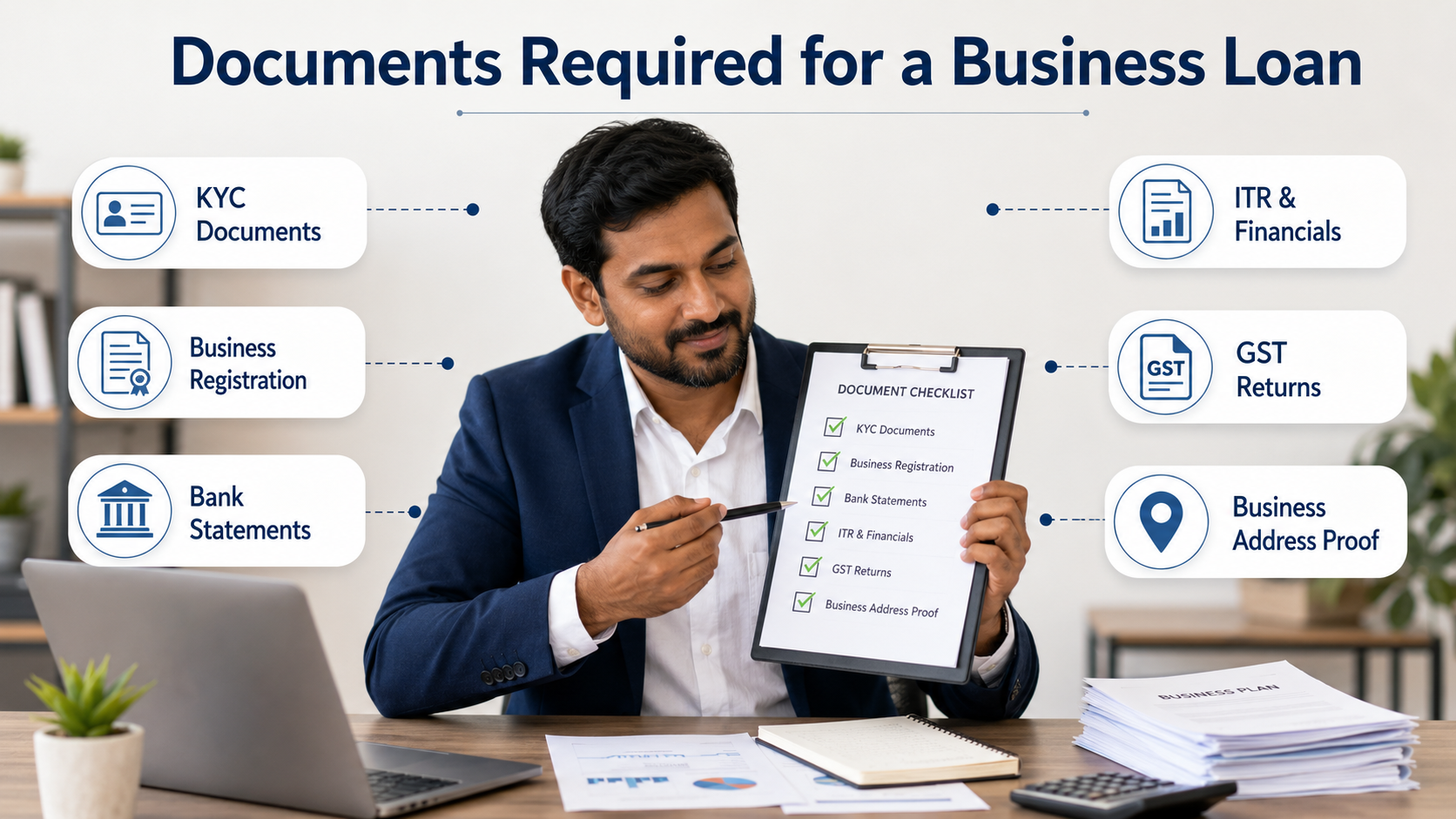
Documents Required for a Business Loan
The required documents may vary depending on the lender, business type and loan amount. However, the following documents are commonly required for business loan applications.
KYC Documents of Applicant
- PAN Card
- Aadhaar Card
- Voter ID
- Passport
- Driving Licence
- Passport-size photograph
Business Registration Documents
- Udyam Registration Certificate, if applicable
- GST Registration Certificate, if applicable
- Shop and Establishment Certificate, if applicable
- Partnership Deed, if applicable
- Company Incorporation Certificate, if applicable
- LLP Agreement, if applicable
- Trade License, if applicable
Financial Documents
- Latest bank statements
- Income Tax Returns
- Profit and loss statement
- Balance sheet
- GST returns, if applicable
- Sales and purchase details, if required
Business Address Proof
- Electricity bill
- Rent agreement
- Property tax receipt
- Shop license
- Utility bill
- GST certificate with business address
Other Documents
- Existing loan details, if any
- Business plan, if required
- Quotation for machinery or equipment, if loan is for purchase
- Vendor invoice, if required
- Collateral documents, if it is a secured business loan
Business Loan Document Checklist
| Document Category | Examples | Why It Is Required |
|---|---|---|
| KYC Documents | PAN Card, Aadhaar Card, Passport, Voter ID | To verify the identity of the applicant |
| Business Proof | GST Certificate, Udyam Certificate, Shop Act, Incorporation Certificate | To verify business existence and legal status |
| Financial Documents | ITR, Balance Sheet, Profit and Loss Statement, GST Returns | To check business income and repayment capacity |
| Bank Statements | Current account or savings account bank statement | To review business transactions and cash flow |
| Address Proof | Utility Bill, Rent Agreement, GST Certificate | To verify business address |
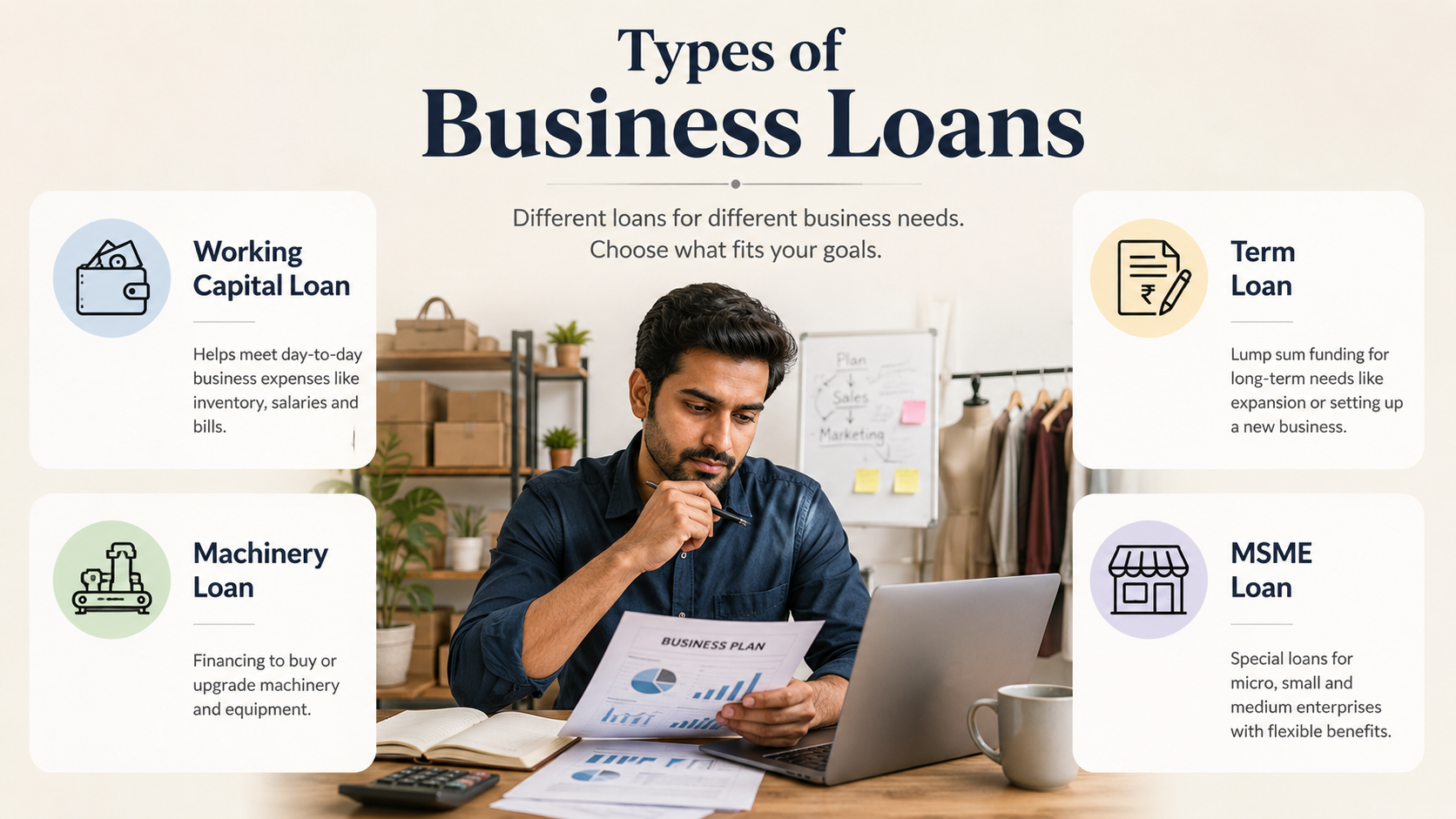
Types of Business Loans
Before applying, it is useful to understand the common types of business loans. The right loan type depends on your business need.
1. Working Capital Loan
A working capital loan is used to manage day-to-day business expenses such as stock purchase, salary payment, rent, vendor payment and short-term cash flow needs.
2. Term Loan
A term loan is usually taken for a specific business purpose and repaid through fixed EMIs over a selected tenure. It can be used for expansion, renovation, equipment purchase or other business investments.
3. Machinery Loan
A machinery loan is used to purchase new machinery, upgrade existing equipment or improve production capacity. The lender may ask for quotation, invoice or machinery details.
4. Loan Against Property for Business
A loan against property is a secured loan where property is used as collateral. It may be suitable for businesses that need a higher loan amount and have property available for security.
5. MSME Loan
MSME loans are designed for micro, small and medium enterprises. Businesses with Udyam registration may be able to access MSME-focused loan schemes and financial products, depending on eligibility and lender policy.
6. Business Overdraft or Cash Credit
Overdraft or cash credit facilities help businesses manage short-term cash flow needs. Interest is usually charged on the amount used, subject to lender terms.
Things to Compare Before Choosing a Business Loan
Do not select a business loan only by looking at the loan amount. You should compare the overall cost and terms before making a decision.
1. Interest Rate
The interest rate directly affects your EMI and total repayment amount. Compare interest rates from different lenders, but also check other charges before choosing an offer.
2. Processing Fee
Many lenders charge a processing fee for loan application and approval. Check whether the fee is fixed or percentage-based.
3. Loan Tenure
A longer tenure may reduce EMI but can increase total interest cost. A shorter tenure may increase EMI but can reduce total interest outgo. Choose a tenure that fits your business cash flow.
4. EMI Amount
EMI should be affordable for your business. If the EMI is too high, it may disturb your cash flow and business operations.
5. Prepayment and Foreclosure Charges
If you plan to repay the loan early, check prepayment and foreclosure terms. Some lenders may charge a fee for early closure.
6. Collateral Requirement
Some business loans may require collateral, while some may be unsecured. Check whether the lender requires property, machinery, fixed deposit or any other security.
7. Total Cost of Loan
Always check the total cost of the loan, including interest, processing fee, documentation charges, insurance charges, GST and other applicable fees.
Business Loan Eligibility Checklist
Before applying for a business loan, review this simple eligibility checklist.
- Is your business active and operational?
- Do you have regular business transactions?
- Is your business bank statement strong enough?
- Do you have valid KYC and business documents?
- Is your credit score or business credit profile healthy?
- Is your existing EMI burden manageable?
- Can your business comfortably pay the new EMI?
- Have you selected the right loan amount?
- Have you compared interest rate and charges?
- Have you checked repayment terms?
Common Mistakes to Avoid Before Applying
Many business loan applications get delayed or rejected because of avoidable mistakes. Try to avoid the following mistakes.
- Applying without checking eligibility
- Applying for a higher amount than required
- Submitting incomplete documents
- Providing incorrect business details
- Ignoring credit score or credit history
- Not checking existing loan obligations
- Not comparing interest rate and charges
- Choosing an EMI that is too high for business cash flow
- Applying with multiple lenders at the same time without planning
- Not reading loan terms carefully before acceptance

How to Improve Business Loan Approval Chances
A good business profile and proper preparation can improve your chances of business loan approval.
1. Maintain Proper Bank Transactions
Lenders review your bank statements to understand business activity. Regular and clean business transactions can create a positive impression.
2. Keep Tax and Business Records Updated
Keep your ITR, GST returns, financial statements and business registrations updated. Updated records make verification easier.
3. Maintain a Healthy Credit Profile
Pay existing EMIs, credit card bills and business liabilities on time. A healthy credit profile can improve your chances of getting better loan offers.
4. Choose an Affordable EMI
Select a loan amount and tenure where the EMI is comfortable for your business cash flow. Over-borrowing can create repayment pressure.
5. Prepare a Clear Business Purpose
A clear loan purpose helps lenders understand how the funds will be used. It also helps you choose the right loan product.
6. Avoid Multiple Random Applications
Applying randomly with many lenders may affect your credit profile. It is better to compare options first and then apply with proper documents.
Important Questions to Ask Before Taking a Business Loan
Before accepting a business loan offer, ask these questions:
- What is the final approved loan amount?
- What is the interest rate?
- What is the total monthly EMI?
- What is the processing fee?
- Are there any hidden or additional charges?
- What is the loan tenure?
- Can I prepay or close the loan early?
- Are there foreclosure charges?
- Is collateral required?
- What happens if EMI payment is delayed?
- What is the total repayment amount?
Secured vs Unsecured Business Loan
| Point | Secured Business Loan | Unsecured Business Loan |
|---|---|---|
| Collateral | Usually required | Usually not required |
| Loan Amount | May be higher depending on collateral value | Depends on business profile and lender policy |
| Processing | May take more time due to collateral verification | Can be faster if documents are complete |
| Best For | Higher loan amount or long-term business need | Working capital or short-term business need |
| Risk | Collateral may be at risk if repayment fails | Credit profile may be affected if repayment fails |
When Should You Apply for a Business Loan?
You should apply for a business loan when you have a genuine business requirement and a clear repayment plan. A loan should help your business grow, improve cash flow or solve an important financial need.
You may consider applying when:
- You need working capital to manage daily operations
- You want to expand your business
- You need to purchase stock or raw material
- You want to buy machinery or equipment
- You need funds for business renovation
- You have stable income and repayment capacity
- You have checked all loan terms carefully
When Should You Avoid Taking a Business Loan?
A business loan should not be taken without planning. Avoid taking a loan if your business cash flow is weak, your existing debt is already high or you do not have a clear plan for using the funds.
You should be careful if:
- Your business income is unstable
- You already have high EMI burden
- You are taking a loan only to cover repeated losses
- You do not know how the funds will be used
- You cannot manage the monthly EMI
- You have not checked the total cost of the loan
How MoneyMangalam Can Help
MoneyMangalam helps business owners understand the business loan process and connect with suitable loan options based on their profile and requirement. Instead of applying randomly, you can get proper guidance about eligibility, documents, loan amount and application process.
Our team can assist you with business loan eligibility guidance, document checklist, application support and basic process understanding. Final loan approval, loan amount, interest rate, tenure and disbursal depend on the lender’s policy and the applicant’s profile.
Frequently Asked Questions
1. What is a business loan?
A business loan is a loan taken for business-related needs such as working capital, expansion, inventory purchase, machinery purchase or other operational requirements.
2. Who can apply for a business loan?
Business owners, self-employed professionals, partnership firms, private limited companies, LLPs, traders, manufacturers and service providers may apply, depending on lender eligibility criteria.
3. Is GST registration required for a business loan?
GST registration may be required depending on the business type, turnover, lender policy and applicable law. Some small businesses may be assessed based on bank statements, ITR and other business documents.
4. Is Udyam registration helpful for business loans?
Udyam registration can be useful for MSME businesses because it helps identify the business as a micro, small or medium enterprise. Some MSME loan products or schemes may ask for Udyam registration.
5. Can I get a business loan without collateral?
Some lenders offer unsecured business loans without collateral, depending on business turnover, credit profile, bank statements and repayment capacity. However, eligibility depends on lender policy.
6. What documents are required for a business loan?
Common documents include PAN Card, Aadhaar Card, business registration proof, bank statements, ITR, financial statements, GST returns, business address proof and existing loan details, if any.
7. Why does a business loan get rejected?
Common reasons include low credit score, weak bank statements, unstable business income, incomplete documents, high existing EMI burden, incorrect details or low repayment capacity.
8. How can I improve my business loan approval chances?
You can improve your chances by maintaining clean bank transactions, keeping documents ready, paying existing EMIs on time, choosing the right loan amount and applying with accurate details.
9. How long does business loan approval take?
The approval time depends on the lender, loan type, document verification and applicant profile. If documents are complete and the business profile is strong, the process can be faster.
10. Should I compare business loan offers before applying?
Yes, you should compare interest rate, processing fee, EMI, tenure, prepayment rules, collateral requirement and total repayment cost before choosing a business loan.
Conclusion
A business loan can be a powerful financial tool when used with proper planning. Before applying, check your exact requirement, business eligibility, documents, credit profile, cash flow and repayment capacity. Also compare interest rates, fees, tenure and repayment terms before accepting any loan offer.
A well-prepared business loan application can save time, reduce rejection chances and help you choose the right funding option for your business.
Need help with a business loan? Connect with MoneyMangalam for business loan eligibility guidance, document preparation and application support.