

Applying for a loan is an important financial decision, but not every loan application gets approved. Many people apply for a personal loan, business loan, home loan or other credit facility without checking their eligibility, documents, credit score and repayment capacity. As a result, the lender may reject the application.
Loan rejection does not always mean that you can never get a loan. It simply means that your current profile may not match the lender’s policy or there may be some issue in your documents, income, credit history or repayment capacity.
In this blog, we will explain the top reasons why loan applications get rejected and what you can do to improve your chances of approval.
Why Do Lenders Reject Loan Applications?
Banks and NBFCs approve a loan only after checking the applicant’s financial profile. They want to know whether the borrower can repay the loan on time. For this, lenders usually check income, credit score, existing EMIs, documents, employment or business stability, bank statements and repayment capacity.
If the lender finds high risk in any of these areas, the loan application may be rejected.
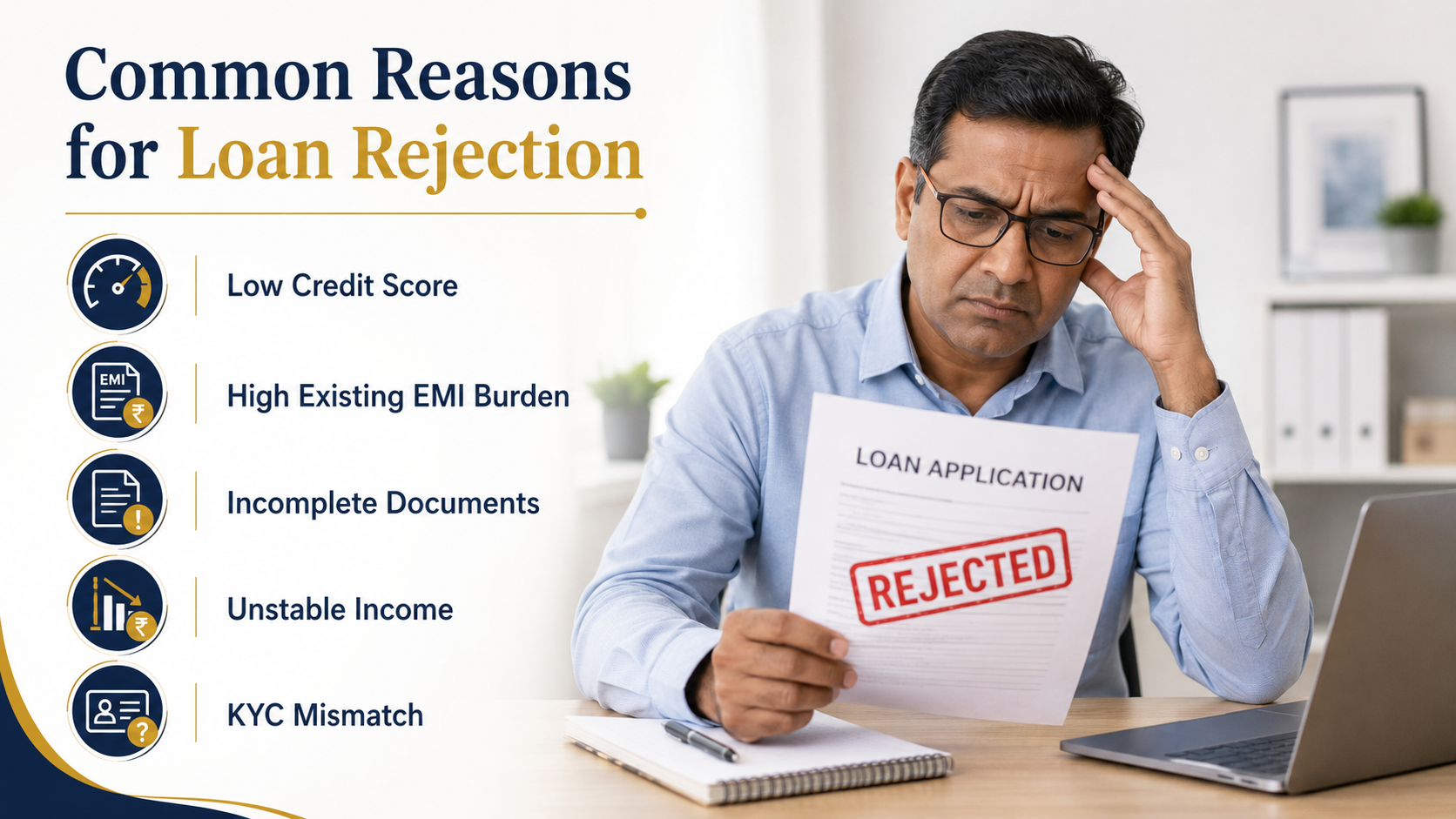
Top Reasons Why Loan Applications Get Rejected
1. Low Credit Score
One of the most common reasons for loan rejection is a low credit score. Your credit score shows your past repayment behavior for loans and credit cards. If you have missed EMIs, delayed credit card payments or defaulted on any loan, your credit score may be affected.
A low credit score makes lenders feel that giving a new loan may be risky. In such cases, the lender may reject the loan application or may offer a lower amount at a higher interest rate.
2. Poor Repayment History
Even if your current income is good, lenders also check your repayment history. If your past record shows repeated late payments, bounced EMIs, loan settlement or overdue accounts, it can reduce your chances of approval.
A clean repayment history builds trust and improves your loan profile.
3. High Existing EMI Burden
If you already have multiple loans or high credit card outstanding, your new loan application may be rejected. Lenders check how much of your monthly income is already going toward existing EMIs.
If your existing EMI burden is too high, the lender may feel that you will not be able to manage one more EMI comfortably.
4. Low or Unstable Income
Income is a very important factor in loan approval. If your monthly income is low or unstable, your application may not qualify for the required loan amount.
For salaried applicants, lenders check regular salary credits. For self-employed applicants and business owners, lenders may check business income, bank statements, ITR and financial documents.
5. Incomplete Documents
Incomplete documents are another major reason for loan rejection or delay. If you do not submit required KYC, income proof, bank statements, business proof or address proof, the lender may not process your application further.
Before applying, always keep your documents ready and updated.
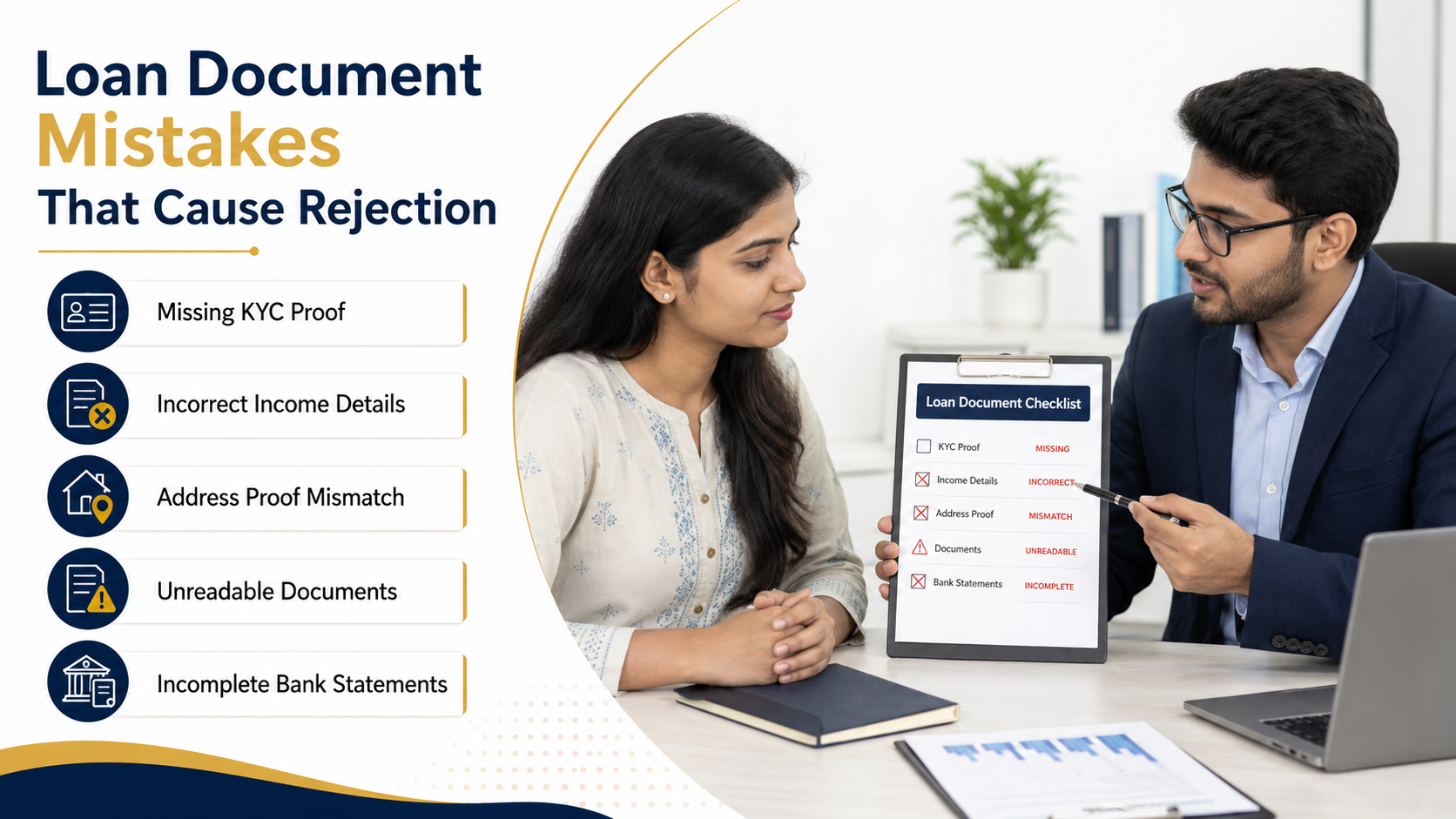
6. Wrong Information in Application
Providing incorrect details in the loan application can lead to rejection. Mistakes in name, PAN, mobile number, address, income, employment details or bank details can create verification issues.
Sometimes, applications are rejected because the details in the form do not match the documents submitted by the applicant.
7. Mismatch in KYC Details
KYC mismatch can happen when your name, date of birth, address or PAN details do not match across different documents. For example, if your Aadhaar Card, PAN Card and bank account have different name spellings, the lender may ask for correction or reject the application.
Make sure your KYC documents are clear, valid and consistent.
8. Frequent Loan Applications
Applying for loans with many lenders within a short period can negatively affect your profile. Multiple applications may create multiple credit enquiries and lenders may consider this as a sign of urgent financial pressure.
It is better to check eligibility first and apply only with suitable lenders instead of submitting random applications.
9. Job Instability
For salaried applicants, lenders may check employment stability. If you have recently changed jobs, have a short work history or work in an unstable income category, the lender may be more careful while reviewing your application.
A stable job and regular salary credits can improve your loan approval chances.
10. Weak Business Cash Flow
For business loans, lenders check business cash flow, bank statements, turnover, ITR, GST returns and financial records. If business transactions are weak or irregular, the lender may reject the loan application.
A business with regular income, proper records and clean bank statements has better chances of approval.
11. High Credit Card Utilization
Using a very high percentage of your credit card limit can affect your credit profile. It may show that you depend heavily on credit. Lenders may consider this as a risk, especially if you also have existing loans.
Try to keep your credit card outstanding under control and pay bills on time.
12. Loan Amount Is Too High
Sometimes, the application is rejected because the requested loan amount is too high compared to the applicant’s income or repayment capacity. Even if your profile is good, the lender may not approve an amount that does not match your income.
Always apply for a practical loan amount that you can comfortably repay.
13. Existing Loan Defaults or Settlements
If your credit report shows loan default, write-off or settlement, it can reduce your approval chances. Lenders usually prefer applicants with clean repayment records.
If there is any old issue in your credit report, try to resolve it before applying for a new loan.
14. Unclear Loan Purpose
In some loan categories, especially business loans, the lender may ask why you need the loan. If the loan purpose is unclear or does not match the loan product, the application may face difficulty.
Before applying, be clear about why you need the loan and how you will repay it.
15. Property or Collateral Issues
For secured loans such as loan against property, home loan or some business loans, the lender checks the property documents, valuation, legal status and ownership. If there is a legal issue, unclear title, low property value or document mismatch, the loan may be rejected.
For secured loans, property documents should be clear and complete.
Loan Rejection Reasons at a Glance
| Reason | How It Affects Approval | What You Can Do |
|---|---|---|
| Low Credit Score | Lender may see higher repayment risk | Pay EMIs and credit card bills on time |
| High EMI Burden | Repayment capacity may look weak | Reduce existing debt before applying |
| Incomplete Documents | Verification cannot be completed | Keep KYC, income proof and bank statements ready |
| Wrong Details | Application may fail verification | Check all details before submission |
| Unstable Income | Lender may doubt EMI repayment ability | Apply after showing stable income records |
| Multiple Applications | May create a negative impression | Apply only after checking eligibility |

How to Avoid Loan Rejection
Loan rejection can often be avoided with proper planning and preparation. Before applying, review your financial profile and documents carefully.
1. Check Your Credit Score First
Before applying for a loan, check your credit score and credit report. If there are errors, overdue accounts or old issues, try to resolve them before submitting a new application.
2. Reduce Existing Debt
If you already have high EMI burden or credit card outstanding, try to reduce it before applying. This can improve your repayment capacity.
3. Keep All Documents Ready
Arrange your PAN Card, Aadhaar Card, income proof, bank statements, address proof and other required documents before applying. For business loans, keep business registration, GST, ITR and financial documents ready.
4. Apply for the Right Loan Amount
Do not apply for an amount that is much higher than your repayment capacity. Choose a loan amount that matches your income and requirement.
5. Avoid Multiple Random Applications
Instead of applying everywhere, compare lenders and apply where your profile has better chances. This helps protect your credit profile and saves time.
6. Provide Correct Information
Always provide accurate details in the application form. Make sure your income, employment, business, mobile number, PAN and bank details are correct.
7. Maintain Regular Bank Transactions
For both personal and business loans, bank statements play an important role. Regular income credits and clean transactions can create a stronger profile.
What to Do If Your Loan Application Is Rejected?
If your loan application is rejected, do not panic and do not apply again immediately without understanding the reason. First, review your profile and identify the possible issue.
You can take the following steps:
- Ask the lender for the reason for rejection.
- Check your credit score and credit report.
- Correct any mismatch in KYC documents.
- Clear overdue EMIs or credit card dues.
- Reduce existing loan burden, if possible.
- Improve income records and bank transactions.
- Apply again only after improving your profile.
Documents to Keep Ready Before Applying Again
If your loan was rejected due to documents or verification issues, keep the following documents ready before reapplying.
- PAN Card
- Aadhaar Card
- Address proof
- Income proof
- Bank statements
- Salary slips, if salaried
- ITR, if self-employed or business owner
- Business registration proof, if applying for a business loan
- Existing loan details, if any
Important Points to Check Before Applying for Any Loan
Before applying for any loan, always check the complete loan terms. Do not decide only based on EMI or loan amount. You should also check the total cost of the loan.
- Loan amount
- Interest rate
- Monthly EMI
- Loan tenure
- Processing fee
- Late payment charges
- Prepayment or foreclosure charges
- Total repayment amount
- Documents required
- Eligibility criteria
How MoneyMangalam Can Help
MoneyMangalam helps customers understand the loan process and prepare better before applying. Instead of applying randomly and facing rejection, you can get guidance about eligibility, documents, loan amount, credit profile and application process.
Our team can assist you with personal loan, business loan and other financial service-related guidance. Final approval, loan amount, interest rate, tenure and disbursal depend on the lender’s policy and the applicant’s profile.
Frequently Asked Questions
1. Why do loan applications get rejected?
Loan applications usually get rejected due to low credit score, weak income, high EMI burden, incomplete documents, wrong details, unstable job or business profile, or low repayment capacity.
2. Can I apply again after loan rejection?
Yes, you can apply again, but it is better to first understand the reason for rejection and improve your profile before submitting a new application.
3. Does loan rejection affect credit score?
A loan rejection itself may not directly reduce your credit score, but multiple loan applications and credit enquiries within a short time may affect your credit profile.
4. Can a low credit score cause loan rejection?
Yes, a low credit score is one of the common reasons for loan rejection because it may indicate higher repayment risk.
5. Why is my loan rejected even with good income?
Even with good income, a loan can be rejected due to low credit score, high existing EMI burden, document mismatch, unstable employment, incorrect details or lender policy.
6. How can I improve my loan approval chances?
You can improve your chances by maintaining a good credit score, paying EMIs on time, keeping documents ready, reducing existing debt and applying for a suitable loan amount.
7. Can incomplete documents lead to loan rejection?
Yes, incomplete or incorrect documents can delay or reject the loan application because the lender may not be able to complete verification.
8. Should I apply with multiple lenders at the same time?
It is better to avoid multiple random applications. Compare eligibility and offers first, then apply carefully with a suitable lender.
Conclusion
Loan rejection can happen for many reasons, such as low credit score, high EMI burden, unstable income, incomplete documents or incorrect application details. The best way to avoid rejection is to prepare properly before applying.
Check your eligibility, review your credit profile, keep your documents ready and apply for a loan amount that matches your repayment capacity. With the right preparation, you can improve your chances of approval and make the loan process smoother.
Need help understanding your loan eligibility? Connect with MoneyMangalam for loan guidance, document preparation and application support.